
It's Official. The Ministry of University and Research (MUR) released the IMAT 2025 Syllabus on 8 August 2025. Here is the breakdown for all candidates.
Registration Window
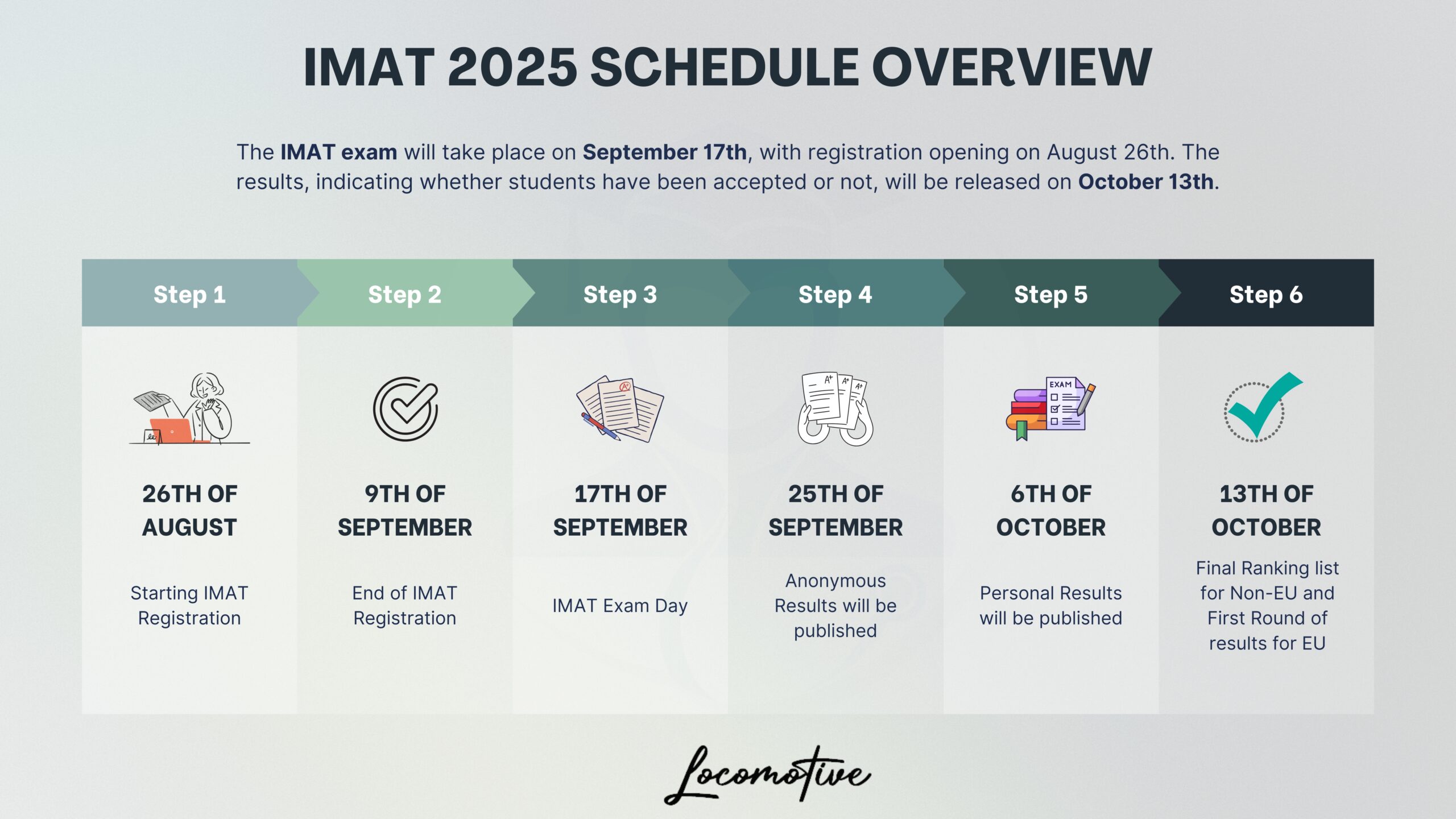
According to the announcement by MUR, registration for IMAT 2025 will open on 26 August 2025 and will close on 9 September 2025 at 15:00 (GMT +2). The exact time the registration opens on 26 August has not been specified, so candidates are advised to regularly check the Universitaly portal throughout the day. IMAT registration will take place through the Universitaly portal. We recommend that students create an account in advance if they don’t already have one.
Format & Questions
The IMAT 2025 exam will last 100 minutes and consist of 60 multiple-choice questions, each with only one correct answer.
Scoring & Ranking Rules
Marking Scheme
- + 1.5 points for each correct answer
- - 0.4 points for each incorrect answer
- 0 points for unanswered questions
To appear on the final ranking as a non-EU student, you must score more than 0 points. To be considered for the EU ranking, you must score more than 20 points.
Tie-Break Hierarchy
In the event of a tie, candidates will be ranked according to the following criteria, in order:
Biology
Higher score in biology
Chemistry
Higher score in chemistry
Physics & Math
Higher score in physics and mathematics
Logic & General Knowledge
Higher score in Logical Reasoning and Problem Solving; then Higher score in comprehension
If scores are still tied, possession of a Language certificate, Disability status, and finally Younger age are used.
IMAT 2025 Syllabus
The IMAT 2025 exam syllabus remains unchanged from previous years. We recommend that students review the detailed IMAT syllabus that our team has previously provided to ensure they are fully prepared.
Biology (23 Questions) expand_more
- The chemistry of living organisms
- The biological importance of weak interactions
- Organic molecules in organisms and their functions; the role of enzymes
- The cell as the basis of life: cell theory, cell dimensions, prokaryotic and eukaryotic cells (animal and plant), viruses
- Cell membrane: structure and functions; membrane transport; cellular structures and their specific functions
- Cell cycle and cell reproduction: mitosis and meiosis, chromosome set, and chromosome maps
- Reproduction and heredity: life cycles, sexual and asexual reproduction
- Mendelian genetics: Mendel’s laws and their applications
- Classical genetics: chromosomal theory of inheritance, patterns of inheritance
- Molecular genetics: DNA structure and replication, genetic code, protein synthesis, prokaryotic DNA, structure of the eukaryotic chromosome, genes, and regulation of gene expression
- Human genetics: transmission of monogenic and polygenic traits; autosomal and X-linked hereditary diseases
- Mutations; natural and artificial selection; evolutionary theories; genetic basis of evolution; heredity and environment
- Biotechnology: recombinant DNA technology and its applications
- Animal and human anatomy and physiology: animal tissues, anatomy and physiology of human systems and organs, and their interactions; homeostasis
- Bioenergetics: the energy currency of the cell (ATP), redox reactions in living organisms, energy processes including photosynthesis, glycolysis, aerobic respiration, and fermentation
Chemistry (15 Questions) expand_more
- Composition of matter: states of aggregation of matter; heterogeneous and homogeneous systems; compounds and elements
- Ideal gas laws
- Atomic structure: elementary particles; atomic number and mass number; isotopes; electronic structure of atoms of different elements
- Periodic table of elements: groups and periods; transition elements; periodic properties of elements (atomic radius, ionization potential, electron affinity, metallic character); relationships between electronic structure, position in the periodic table, and element properties
- Chemical bonding: ionic, covalent, and metallic bonds; bond energy; bond polarity; electronegativity; intermolecular bonds
- Basics of inorganic chemistry: nomenclature and main properties of inorganic compounds (oxides, hydroxides, acids, salts)
- Chemical reactions and stoichiometry: atomic and molecular mass, Avogadro’s number, mole concept and applications, basic stoichiometric calculations, balancing simple reactions, types of chemical reactions
- Solutions: solvent properties of water, solubility, main ways of expressing solution concentration
- Equilibria in aqueous solution
- Elements of chemical kinetics and catalysis
- Oxidation and reduction: oxidation number, concept of oxidizing and reducing agents, balancing simple reactions
- Acids and bases: concepts of acid and base, acidity, neutrality, and basicity of aqueous solutions; pH; hydrolysis; buffer solutions
- Basics of organic chemistry: carbon–carbon bonds; empirical and structural formulas; concept of isomerism; aliphatic, alicyclic, and aromatic hydrocarbons; functional groups (alcohols, ethers, amines, aldehydes, ketones, carboxylic acids, esters, amides); basic nomenclature
Physics & Math (13 Questions) expand_more
Mathematics:
- Number sets and algebra: natural numbers, integers, rational and real numbers; ordering and comparison; order of magnitude and scientific notation; operations and their properties; proportions and percentages; powers with integer and rational exponents and their properties; roots and their properties; logarithms (base 10 and base e) and their properties; basics of combinatorics; algebraic expressions and polynomials; special products; nth power of a binomial; polynomial factorization; algebraic fractions; first- and second-degree equations and inequalities; systems of equations.
- Functions: fundamental concepts of functions and their graphical representations (domain, codomain, sign analysis, continuity, maxima and minima, increasing and decreasing behavior, etc.); elementary functions (polynomial, rational, exponential, logarithmic, and trigonometric); composite and inverse functions; trigonometric equations and inequalities.
- Geometry: polygons and their properties; circumference and circle; measurement of lengths, areas, and volumes; isometries, similarities, and equivalences in the plane; geometric loci; measurement of angles in degrees and radians; sine, cosine, tangent of an angle and notable values; trigonometric formulas; solving triangles; Cartesian coordinate system in the plane; distance between two points and midpoint of a segment; equation of a line; conditions for parallelism and perpendicularity; distance from a point to a line; equations of the circle, parabola, hyperbola, and ellipse, and their representation in the Cartesian plane; Pythagoras’ theorem; Euclid’s theorems (first and second).
- Probability and statistics: frequency distributions according to the type of variable and main graphical representations; concepts of random experiments and events; probability and frequency.
Physics:
- Physical quantities and measurement: fundamental and derived quantities; measurement systems (International and Technical); multiples and submultiples; scientific notation; main conversions between different unit systems; scalar and vector quantities; vectors and vector operations.
- Kinematics: description of motion; velocity and angular velocity; acceleration and centripetal acceleration; uniform linear motion; uniformly accelerated motion; uniform circular motion; harmonic motion.
- Dynamics: concept of force as an interaction between bodies; forces as applied vectors; principle of inertia; mass and Newton’s second law of motion; examples of forces (weight, elastic force, static and dynamic friction); action and reaction (Newton’s third law); impulse and momentum; principle of conservation of momentum; torque and angular momentum; work and kinetic energy; conservative forces and potential energy; principle of conservation of mechanical energy; power.
- Fluid mechanics: density and compressibility of fluids; gases and liquids; hydrostatics (pressure, Pascal’s principle, Stevin’s law, Archimedes’ principle); fluid dynamics (one-dimensional motion, flow rate, continuity equation); ideal fluids and Bernoulli’s equation; viscous forces in real fluids.
- Thermodynamics: equilibrium, concept of temperature, thermometers; concept of heat and calorimetry; modes of heat transfer; heat capacity and specific heat; phase changes and latent heats; ideal gas laws; first and second laws of thermodynamics.
- Electricity and electromagnetism: electric charges; forces between charges and Coulomb’s law; electric field and potential; equipotential surfaces; dielectric constant, capacitance, capacitors; electrostatic energy; capacitors in series and parallel; generators; electric voltage; electric current; resistivity, resistance, resistors; Ohm’s law; resistors in series and parallel; Kirchhoff’s laws; work, power, Joule’s effect; direct and alternating current; period and frequency; magnetic field of an electric current; forces on electric currents in a magnetic field; electromagnetic induction.
General Knowledge, Reading Skills & Logical Reasoning (9 Questions) expand_more
1. Reading skills and knowledge acquired during studies
- The ability to understand written texts in English of various types and for different communicative purposes is a transversal skill, as all question types will be formulated in English, including the use of symbolic language.
- The following skills will also be specifically assessed: Understanding abstract, uncommon, or specialized vocabulary in real contexts. Identifying phenomena of textual cohesion and coherence. Extracting and inferring specific information from the text.
- These skills will be tested using short texts from scientific essays or from classical and contemporary literature, as well as brief current affairs articles published in newspapers and in generalist or specialized magazines.
- Using short texts of various types and themes, the exam will also assess the knowledge acquired in previous studies and general culture, including topics of supranational relevance or subjects of contemporary public debate. In particular, the questions will aim to verify: The ability to orient oneself in the represented space and time, i.e., to place significant historical-cultural phenomena in their spatial and temporal context. Knowledge of the main national and international institutions. Understanding of phenomena related to legal, economic, and citizenship matters.
2. Logical reasoning and problem-solving
- The questions are designed to assess the ability to logically complete a line of reasoning in a way that is consistent with the given premises. These premises may be presented in symbolic or verbal form and may concern cases or problems — including abstract ones — whose solution requires the application of various forms of logical reasoning.
Language Certificates (CEFR Equivalencies)
The following certificates are recognized by Italian Universities for tie-breaking purposes. The table below lists the specific certificates required for each level.
| Ente Certificatore | Level | Certificazione di lingua inglese per le 4 abilità |
|---|---|---|
| Cambridge English Language Assessment | C2 | Cambridge English: Proficiency (CPE) |
| C1 |
Cambridge English: Advanced (CAE) Cambridge English: Business Higher (BEC Higher) |
|
| B2 |
Cambridge English: First (FCE) Cambridge English: Business Vantage (BEC Vantage) |
|
| City and Guilds (Pitman) | C2 | Level 3 Certificate in International ESOL Diploma Mastery C2 |
| C1 | Level 2 Certificate in International ESOL Diploma Expert C1 | |
| B2 | Level 1 Certificate in International ESOL Diploma Communicator B2 | |
| Edexcel / Pearson Ltd | C2 | PTE General Level 5 Proficient |
| C1 | PTE General Level 4 Advanced | |
| B2 | PTE General Level 3 Upper Intermediate | |
| EDI (LCCIEB) | C1 |
JETSET Level 6 English for Business Level 4 |
| B2 |
JETSET Level 5 English for Business Level 3 English for Commerce Level 3 |
|
| IELTS | C2 | IELTS band 8.5 – 9.0 |
| C1 | IELTS band 7.0 – 8.0 | |
| B2 | IELTS band 5.5 – 6.5 | |
| TCL Trinity College London | C2 | Integrated Skills in English (ISE) IV |
| C1 | Integrated Skills in English (ISE) III | |
| B2 | Integrated Skills in English (ISE) II | |
| TOEFL ETS | C1 | TOEFL score 110–120 |
| B2 | TOEFL score 87–109 |
Suggerimento: scorri orizzontalmente su schermi piccoli.
Start Studying Today
Review the complete, official syllabus breakdown to ensure you don't miss a topic.